Here's another C:AJ tasting from the vault. It's a swiss cheese that we did not like. To quote myself, "it tastes like dirt." I'll let you watch the vid (below) to find out the whole story.
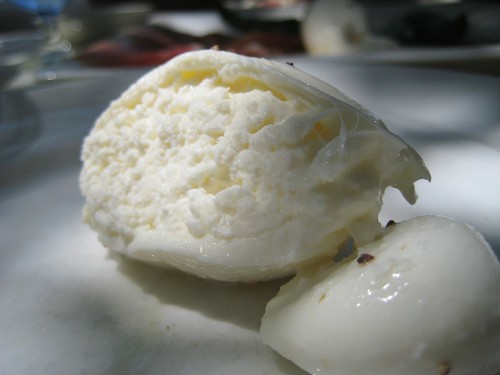
This tasting also resulted in some of our finest cheese photography:
I hope you enjoy watching the tasting more than we enjoyed eating the cheese!
We just got back from cheesecation, and we're ready to eat. As we search for the perfect back-to-tasting cheese for our next review, we thought we'd share with you a video from the archives. Regular readers will know that this sort of several-month aging process merely serves to bring out the flavors in a good cheese... video... right?
Enjoy, and look back here for fresh posts this week!
In our tasting of Farmer John's Parmesan, we implied that the lingering nutty-meatiness of Parmesan just begs for a good pairing. This might have been correct in theory, but... well, just watch. It seems we need a little pairing practice.
This week, C:AJ is going back to basics with a standard cow's milk Parmesan. No crazy animals, no added spices, just a solid wedge of one of the world's most recognizable and beloved cheeses.
Background:
We purchased this Parmesan from the Farmer John's cheese stand at the East Side Farmers' Market. (Check out F.J.'s straightforward description of his Parmesan here.) We're pretty sure this Farmer John is located in Spring Green, WI (source: L'Etoile Restaurant) - if anyone else has more information about the operation, let us know! Otherwise, we'll check in with him again at the next market.
This cheese is technically a Parmesan-style cheese - "Parmesan" and "Parmigiano-Reggiano" being protected designations of origin reserved for cheeses made in or around Parma, Italy, at least when the cheese is sold within Europe. (Felix, we know you would insert a cheesy - haha - "Celestesan" joke here.) By definition, European Parmigiano-Reggiano is made between May and November, using a combination of today's whole "morning milk" and skimmed "evening milk" from the night before.
Parmesan is a cooked cheese, meaning that the milk is heated to temperatures over 100 degrees Fahrenheit during the process (in this case, twice). In a unique twist on the basic cheese-making process, proto-Parmesan curds are broken up mechanically into rice-sized pieces after the first heating; after being reheated, the whey is drained and the curds are poured into round molds. After a few days of rest, the resulting cheese is soaked in a brine bath and allowed to age for at least 12-14 months in the U.S. (True Parmigianos are typically aged at least 2 years in Europe. If the cheese makes it to 3 years it is deemed "stravecchio" (extra old!), and a 4-year-old morsel earns the label "stravecchione" (super extra old!).) Parmesan-style cheese is typically aged in a very humid environment, and Farmer John - let's just assume that's the vendor's real name - told us that his Parmesan needs to be wiped dry every 3 days for the first year or so. Phew! For such a popular item, Parmesan is quite a picky little cheese...
Parmesan-style cheeses are known for being hard, dry, granular, salty, and nutty. They're often grated (quick tip: try grating your own! It's far superior to Kraft...), but true connoisseurs (at least the ones on Wikipedia) advocate strongly for Parmesan to be eaten as table cheese.
This makes us true connoisseurs.
The Taste:
This cheese is satisfying to slice: it's hard enough to make nicely shaped slices, but not so hard that your knife gets stuck halfway through. This Parmesan (like many dry, aged cheeses) has a flaky, slightly crystalline texture - toothsome when chewed (possibly due to the breaking up of the curds?). Kara is an official "toothsome" fan.
As soon as the slice hits the tongue, the salivary glands go crazy! (At least ours do.) We don't think this cheese was very sour at all... can savory flavors make one's mouth water? This Parmesan is salty and sweet, with a strong (and delicious) nutty/meaty flavor that really fills the mouth. The taste lingers for a while, just begging for a good pairing...
By Erica and Kara We recently purchased a cheese from Nordic Creamery at the East Side Farmers' Market in Madison. Nordic Creamery makes goat and cow's milk cheeses, and they don't have a stand at Madison's Saturday market-- although the family-owned farm is located in Westby, Wisconsin, they cross the border into Illinois on the weekend to hock their goods at the Lincoln Park Farmers' Market in Chicago.
Background: We tried a Feddost cheese, which is a cow and goat milk cheese made with a "curd infusion" of cumin and cloves. Nordic Creamery says that Feddost is "a Norwegian flavor tradition with a sweet and spicy flavor."
The Taste: Feddost was a stretch for C:AJ - neither of us thought that we liked flavored cheeses, preferring instead flavors that arise from your basic milk, rennet, and bacteria. Feddost proved us (somewhat) wrong. We enjoyed how seamlessly the spices were incorporated into the cheese - the sweetness (clove) and savoriness (cumin) tasted and felt like they were organic to the creation of this cheese, rather than being added in at the last minute. (Perhaps this is the advantage to "curd infusions," which take place so early in the process.) Feddost has a pleasing texture: medium-soft and smooth, excellent for a hard cracker. Kara would suggest this as an interesting addition to an appetizer plate - funky, thoroughly approchable, yummy... at least for a few bites. Several pieces in (after the cameras stopped rolling), the flavor becomes a little tedious... It's a pretty simple flavor, albeit unusual. It wasn't our favorite cheese, by any means, but it's worth a taste. We'll be on the lookout for other "curd-infused" cheeses for comparison.
True to our word, we found some Parrano to taste! See our recent post on the background of "the Dutch cheese with an Italian accent" here.
Before we discuss the taste of Parrano, a quick note on this picture: this mostly-sepia tone image of Parrano in its (?) natural environment presently takes up 80% of the German Parrano homepage (similar images seem to cycle through the English, Dutch, French, German, and Spanish sites unpredictably). Other shots feature a cityscape and an overturned glass, and a long-exposure image of a wine glass tipping and a man struggling to catch it. Caution: Parrano appears to induce eerie happenings at the dinner table.
The Taste: Descriptions of Parrano as a hybrid of Parmesan and Gouda are ubiquitous, and accurate. We also detected a strong resemblance to Swiss cheese, both in flavor (nutty, sweet) and in texture (medium in firmness, holey). On first taste, we liked this pleasing flavor combination and the toothsome feeling of the cheese in the mouth. The cheese is very flavorful, without a hint of anything off-putting or overly complex - a definite crowd-pleaser. The major downside of Parrano is the rind: made of several layers of wax, it feels sticky and (understandably) waxy, and imparts a bland plastic flavor to the outer edges of the cheese. We're pretty positive in the first few minutes of tasting and talking (see the video below), but it should be noted that our opinion of Parrano started shifting as we became aware of the rind problem, and continued to decline after we stopped shooting and became aware of a sort of sweet, processed aftertaste. On the other hand, a second, informal tasting of Parrano by Kara - in the context of a turkey and lettuce sandwich - highlighted Parrano's strength as a sandwich cheese. We probably wouldn't serve it on a cheese plate, but Kara at least is curious to try it in an omelette or over a salad.
A few months ago, we and a few other friends casually enjoyed a sheep milk Brie. Well, to the others it was casual. We, of course, knew we'd have to come back to contemplate it more seriously. Today's cheese is a French Rocastin Sheep Milk Brie from the Willy St. Co-op.
Background: Rocastin (also know as "Berger de Rocastin" and "Fromage de Brebis") is a French brie-style cheese, made with sheep's milk (hence the French references to shepherds and ewes). In general, Brie cheeses are distinguished by their soft and creamy texture and rich flavor - two cow's milk varieties are protected by the A.O.C. (Brie de Meaux and Brie de Melun), and a wide array of Brie-style cheeses are available and extremely popular in the U.S. Brie cheese are often relatively young (4-5 weeks) and most easily recognized by their circular or wedge-like shape, their white, "bloomy" rind, and their oozingly creamy center.
There is very little information about Rocastin out there: most descriptions center on the "velvety rind," which is pretty typical for any Brie-style cheese. Rocastin is produced in the Rhone-Alps region of France. Immediately apparent differences between Rocastin and more common varieties of "Brie": sheep's milk and a triangular shape. (It's produced in a rectangular rather than a circular mold, leading us to wonder about the effects of corners on its taste...)
The Taste: Although we have a (possibly biased) soft spot for goat's milk cheese, this sheep brie is absolutely delicious. Like with goat's milk cheeses, though, it has grassy, earthy notes. We enjoyed this added complexity! In terms of texture, sheep milk brie is everything cow milk brie is, but to the extreme. The higher fat content in sheep's milk makes the cheese very rich and creamy. It's thick and sticks to the roof of your mouth (in a decadent--not disgusting--way).
If you love brie but are bored with the typical selections, try some sheep!
After our last FACTS post on mozzarella, we thought it would only be appropriate if we tasted a mozzarella as well. We hope you appreciate our consistency.
Background: We purchased this fresh mozzarella from the Jenifer Street Market. It came in a container of brine with no information on the label (except, of course, the price). Where is it from? Who made it? We do not know. We can only assume it was made from cow's milk.
But, if you want to know more about mozzarella in general, see the previous FACTS post about this glorious cheese.
The Taste: We did not have as much to say about this cheese, as it is much simpler than the cheeses we usually taste. Since mozzarella is so fresh (it is best eaten the day it is made), there is no time for bacteria to grow and flavor the cheese. It tastes--as we say in our video many, many times--like milk. If milk were a solid, it would be mozzarella. Actually, mozzarella essentially is milk as a solid, so this analogy is not an analogy at all.
As for the texture, we noticed that the outer layer was stringy, much like string cheese, which is indeed a lower moisture, more processed form of mozzarella. The inside was more firm and had a grainier texture. Because the cheese is so simple, we also discussed why we think mozzarella is usually paired with tomato and basil. Watch the video to hear what we have to say!
Some of you may remember a time when we were but lowly cheese fans, when had no words to describe the sensations we experienced, no knowledge to impart upon our readers, and no venue to acquire such knowledge.
Times have changed.
Last Saturday, we spent the morning working at the Capri Cheesery stand at the Dane County Farmers' Market, under the tutelage of Felix, the man behind some of our favorite cheeses. (See our very first TASTES post here, and a later Capri tasting here.) We learned a lot and had a blast, and we look forward to writing more detailed posts soon on topics as diverse as cooking temperatures, chemical compounds, and, of course, how hard it is to milk a bear. (Ask Felix.)
We'll be working at the Capri stand Saturday mornings - stop by and sample some cheese!
At some point in Erica's birthday festivities, she received a mysterious package containing three varieties of cheese from Artisanal Premium Cheese. Though the origins of the gift were eventually determined, the excitement and allure of the unexpected cheese delivery endured. We couldn't resist eating the Majorero Pimenton straight out of the package... But we summoned up enough self-restraint to catch Mystery Cheese #2 on video.
Background: Pecorino Balze Volteranne is a raw sheep milk cheese from Italy. "Pecorino" is a label applied to any Italian cheese made from the milk of a sheep (una pecora! -- or perhaps more than una, but we don't know how to pluralize in Italian). The Balze di Volterra, or Cliffs of Volterra, are located in Tuscany, and provide a breathtaking backdrop for cheese-crafting. P.B.V. is a mouthful of a name for a mouthful of cheese; see our video for a thoroughly unilluminating discussion of how (not) to pronounce it.
Artisanal provides very thorough introductions to their cheeses, as well as suggestions about wine and beer pairings. According to their description, P.B.V. is a firm, toothsome ("al dente!") cheese with "a nutty texture" that pairs especially well with red wines, such as sangiovese/chianti. The flavor is supposed to call to mind green olives, due to a 60-day aging process involving the ash of oak and olive trees. Some sources suggest that Pecorinos like P.B.V. are used mainly in cooking, and may be freely substituted for Parmesan... but we decided to forgo the grating and take a big bite right out of the hunk.
The Taste: This is the first cheese of which we'd read a detailed description before we had our first bite. We noticed right away the firmness described by the distributor. Kara in particular loved the hard-but-not-crumbly texture. The cheese has a complex taste that starts off mild and creamy before spreading over the tongue and waking up. The taste lingers and becomes stronger, with grassy, leafy notes coming through. We could taste the influence of the olive wash on the rind. This cheese is less pungent than most of the cheeses we've tasted (and loved) previously, but it still has a very unique taste. We recommend it for beginning and advanced cheese tasters alike!
This past week we tasted Saint-Nectaire, which we purchased at the Willy St. Co-op with our guest taster, Camila.
Background: Saint-Nectaire, a French cow's milk cheese, is made in Auvergne, France. This little region is very proud of its cheese, which they've made since the 17th century. Their website includes the heading, "Auvergne and Saint-Nectaire.... or when love rhymes with passion." This is either a translation error or the words of a very poetic community.
Saint-Nectaire was the first farmer's cheese to receive AOC certification. The AOC stamp means that true Saint-Nectaire must come from Auvergne. To make the cheese, the curds are gathered into a single tomme, which is later cut into small cubes and pressed into small circular moulds by hand. It is then salted and pressed for one day. The last step is a drying period of about 8 weeks, during which it is twice washed in brine. Traditionally, the cheese is dried on rye straw. Because Saint-Nectaire is from a specific region, it is said to pick up is mushroomy and nutty taste from the vegetation around where it ripens.
The Taste: We have a variety of strong and varied reactions to this cheese! Much more of a dynamic and emotional experience than our typical "Mm, I like it... In fact, I really like it." We primarily credit the cheese, of course, but also Camila, whose scientific insights are truly invaluable to this review. (For specifics, see the video below.)
The Saint-Nectaire is very smelly, especially when allowed to warm up to room temperature. (We're coming along in our cheese practices: this may have been the first time we've had enough patience to experience any cheese at room temperature.) It's a semi-soft cheese, though more rubbery than creamy in consistency.
But enough about smells and textures: it's the taste of Saint-Nectaire that makes the biggest impression... or rather, impressions. Erica's first reaction: very positive. Kara: neutral. Camila: "It smells like E. Coli to me." Initially, there's some potential for a mild to moderate disgust reaction to the moldy taste and slimy feel on the tongue, but the gross-out period seems to be longer for some tasters than others (possibly depending on your level of expertise with regards to mold and bacteria; those who have spent time working with strains of either may not want a smell that usually wafts out of a petri dish to linger on their taste palate).
As the chewing continues, the taste continues to unfold into a complex experience of strong, interlocking flavors. The cheese is sweet, especially at the beginning, increasingly sour toward the end, and very salty throughout. It's also much creamier in taste than it feels in texture. The Dolmen label promises hints of "grasses, flowers, and herbs," which we didn't quite detect... However, after much debate, we are now in agreement that--mildewiness notwithstanding and regardless of the presence or absence of flora flavors--Saint-Nectaire is a supremely tasty cheese. And not for the faint of heart.
Our one failing in this tasting: neglecting our new interest in pairing! Baguette is a safe choice for this fromage, but we promise to be more adventurous next time.
Background: This week, we returned to the Dane County Farmer's Market. Now that it's moved to the senior center, we weren't sure if we'd see any familiar faces but to our surprise and delight, Felix himself was manning the Capri Cheesery table. If you remember, dear reader, our first tasting was one of Felix's cheeses. We won't go over the details of Capri here, so click on the above link if you want to know more about Felix and his goats.
The Taste: The cheese is white and crumbly, hard to cut neatly. Sitting on the plate, it smells deliciously, quintessentially, cheesey. At first the goaty pungency overwhelms the tang we expect from a cheddar, but by the end of the bite its sour zing asserts itself. It's a strong flavor, mouth-filling and smooth. Whenever we think of cheddar, we think of Cracker Barrel. Capri's version of aged cheddar is C.B. to the power of ten, in both strength and complexity. In short: delish.
In addition to the cheese that Kara and I eat every week (Note: her return to America will also mark a return to the blog's regular schedule), I buy an average of two cheeses a weeks for myself. As a rule, one of them is a melting cheese, such as Cheddar or Monterey Jack, and one is something new; my morning routine often includes an open-faced grilled cheese sandwich, and my afternoon routine often includes cheese and crackers. I am also lactose intolerant, but that's a story for another time. THIS entry is about the new cheese that I bought recently: Port-Salut.
Background: Port-Salut is a cow's milk cheese from Brittany, France. It is very soft, has an bright orange rind and was the first French cheese to be made from pasteurized milk. Created by Trappist Monks in the 1800s, the head of the abbey gave the rights of the cheese to a distributor in 1873. Although Port-Salut is still handmade, today the cheese is mainly mass produced. The wedge I bought, for example, was made by Fromageries Bel, France's third largest cheese producer.
The Taste: I did not like this cheese. Although it is known for its mildness, it was a bit too mild for me. The slightly tangy (and short lived) aftertaste was plastic. Its creamy texture seemed artificial, reminding me of Laughing Cow (and I hate Laughing cow.) This, perhaps, is not surprising since Fromageries Bel is the maker of Laughing Cow. I feel like I've been duped (N.B. I did my research post-purchase, post-taste, post haste). Is this what a real Port-Salut tastes like? I doubt it.
Lesson: Look at the fine print on a cheese's label. If it says "Fromageries Bel," do not buy. Boycott!
South Africa continues to satisfy this turophile (see below). I tried another two cheeses this week and found them very palate-pleasing.
INDEZI RIVER CHEESE COMPANY: NANDI MATURE GOAT'S MILK CHEDDAR
Background: The first was a goat's milk cheddar from the Indezi River Cheese Company, based in the Natal Midlands. Indezi appears to be an up and coming cheese company, "certified free range" (a cheesery after a Mad-townie's heart, though not quite as socially just and hippie qualified as Fairview). Again, they use imported Saanen goats, which makes me wonder if any South African cheese-makers use indigenous animals. Indezi has a very entertaining website, including a "Helpful Hints" section, including highlights such as "The blue in blue cheese is NOT melted copper wire, but a harmless penicillin mould," and "It is best to keep cheese in the bottom part of your fridge," and "Turophile is the official term for a cheese lover." All, for various reasons, very good to know!
They describe their "Nandi" as "a traditional farm style cheese," which I think means that it is pretty young (fresh) and quick to mature. They say it should be "slightly dry and a little salty with a piquant aftertaste" (note to self: add "piquant" to the vocab list). They also note that Nandi is "a regal cheese fit for a queen," which is somewhat harder to verify.
The Taste: I found Nandi to be a very pleasant cheese, given that it wasn't especially exciting. It was extremely mild, more like a mozzarella flavor than a strong cheddar, although there was a hint of the sharp sourness that I would expect in a cheddar. The texture was very smooth and soft. I think this would be a good cheese for the sensitive-tongued. It was especially yummy on a bagel chip.
FAIRVIEW ROYDON CAMEMBERT Background: The second cheese came from Fairview, like the Crottin I loved last week. I'd give top marks to Fairview!! Given the abundance of Fairview cheeses and wines at the local grocery store, so would the rest of Cape Town (or at least the ritzy gay men who frequent the De Waterkant neighborhood).
The Taste: Definitely Camembert! The cheese was very oozey and creamy, and melted almost to a liquid as it warmed up to room temperature. It was much more fluid than our last Camembert. It had that distinctive zing at the back of the mouth, but was otherwise fairly mild, with a markedly mild rind. Very tasty!
I'm currently in Cape Town, South Africa, and although I'm technically here on "business," I'm doing my best to nab some local cheese. Luckily, there's a swanky little grocery store just a block down the street, with plenty of specimens in stock. So far, it's a mixed bag: meet Caerphilly (a little gross) and Crottin (quite delish), my first tastes of South Africa. (Thanks to a trio of colleagues for their input on this post.)
ENGLISH CAERPHILLY Background: Caerphilly (pronounced "care-FILL-y," although I can't help just saying "carefully") originated in Wales, although it is now widely produced throughout southern England. A "quick cheese," which matures rapidly to sell-ability, Caerphilly is also very high in salt. This was a successful combination in the 19th century, when farmers were looking for ways to sell off excess milk and sweaty miners were looking for ways to replenish their salt. The town of Caerphilly continues to celebrate its eponym with a three-day festival in July called "The Big Cheese."
Caerphilly is a hard white cheese, mild and salty in flavor. Originally, the cheese was creamy around the edges and more crumbly toward the center, but modern Caerphilly is pretty uniformly dry and crumbly. It benefits from moisture and supposedly shouldn't be "suffocated" by plastic wrap... Unfortunately, ours was shrink-wrapped upon purchase, which may have contributed to its grossness. The package didn't include any information on the cheese's origin or ingredients.
The Taste: I did not like this cheese. The texture was interesting, much drier than other cheeses we've tried, somewhere in between the smoothness of Cheddar and the flaky dryness of Parmesan. At first, it tasted all right - mild and salty, a little bitter and a little sweet, but nothing overwhelming or offensive. Fellow tasters suggested it was similar to Spanish cheese, but a little more flavorful. But as I continued to consume, I had a lurking sense of something distinctly inedible, a flavor almost chemical, similar to gauze... a Bounce dryer sheet. To me, this cheese tasted exactly like a Bounce dryer sheet. Since making that realization, I can't really enjoy the cheese anymore. Sorry, Caerphilly, but I don't think I'll be attending "The Big Cheese" any time soon.
CROTTIN Background: The name "Crottin" might have derived from the word "crot," a small oil lamp made from burned clay, which sort of resembles a cheese mold. The more likely story, however, appears to be that "crottin" refers to "dung," which is what this cheese comes to resemble as it ages. No matter. It's still the most famous goat cheese to come from the Loire Valley (France), and descriptions of the cheese are glowing: a cheese with a "pleasant tanginess, fine, marble-like texture, with a long and nutty finish... moist and lactic when young, dry and nutty when aged."*
The name "Crottin de Chavignol" is under AOP protection (like Camembert), but the technique is used throughout the world to produce plain old Crottin. This particular little morsel comes from Fairview Wine and Cheese, headed by Cyril and Charles Back. Cyril first brought Swiss Saanen goats to Fairview in 1980 - supposedly, goats milk cheese was unknown in South Africa up to that point. A few years later, they introduced some cows to the mix (our Crottin is a blend). The business has blossomed: Fairview is currently the country's leading producer of artisanal and specialty cheeses, and their Roydon Camembert voted best in the world for three years in a row at the World Cheese Awards in London. (Their wine also gets very high marks.) Beyond purely gustatory concerns, Fairview is also renowned for excellent employment practices, including providing employment, housing, travel, and education to underprivileged workers in the surrounding area. Farm workers at Fairview have even started produced wine under their own "Fair Valley" label, with all proceeds going directly to their association. (Madisonites would love this place.) Crottin Ingredients: - Pasteurised goat's milk - Jersey milk - mixture of microbiological cheese cultures - non-animal rennet - salt
The Taste: So much yummier. Fairview's Crottin was very sharp, very sour, and very milky. It wasn't especially smooth, and was actually much closer to being crumbly. Compared to other goat's milk cheeses, this one was pretty dry, but similarly dense and firm. It had a thin, bitter rind, which never overwhelmed the flavor of the cheese itself. There was significant variation from rind to center, both in terms of texture (dry to creamy) and taste (bitter to sour/fatty). Maybe it was just an effect of contrast, but I really liked this cheese.
Sorry no video! But we just bought two more cheeses, so stay tuned...
'Tis the season-- sparkly lights, fragrant trees, gift-wrapped presents, and, most importantly, lots of dinner parties. Dinner parties mean appetizers, and appetizers mean cheese. Usually, the spread includes a orange and white striped wedge of cheddar, some kind of blue cheese, and maybe a Brie. Sometimes, though, there's something new. Last night, for instance, my family brought three cheeses to a friend's house. If it were last year, I would have shoveled lots of cheese and bread into my mouth (politely, of course), noted that they all tasted pretty good, and moved on. This year, however, as co-author of this cheese blog, I decided to do some research on the wheels and wedges that we enjoyed.
1) Saint Faron This cheese, a wheel with a diameter of about five inches and a height of about four, is a cow's milk triple crème from France. Triple crèmes are cheeses to which cream is added to increase the butterfat content of the solid ingredients to 75% (overall, the fat content is about 40%). Other triple crèmes include mascarpone and St. André. As you can imagine, this cheese was very smooth. Like the Camembert we tasted earlier, it essentially melted in my mouth (I didn't lick this cheese as we did the Camembert because I was in public). It is an incredibly lush, full cheese. This lushness seemed to overwhelm any subtle notes that may have existed, which isn't a bad thing. To me, triple crèmes are about richness. In a country that despises and avoids fat like the plague (when, in fact, fat is a crucial ingredient to many of the most tasty foods), it is very pleasing to eat a cheese for which the fattiness is the point of it all.
2) Mousseron Jurassian A harder, but still sliceable, wedge, this is a Jura Mountain cheese like Gruyère or Comté. The Jura Mountains are a part of the Alps that span Germany, Switzerland, and France. Because of the dense vegetation in this area, many its cheeses have an earthy taste. Mousseron Jurassian is made from raw cow's milk. I liked the cheese's even texture, and it is more mild than many of the cheeses that Kara and I have tasted thus far. M.J. is a very pleasant cheese, but not a stand out. If stronger cheeses are like the flashy, colorful Christmas decorations that wow the neighbors, M.J. is like a string of those white, tasteful lights that make a quiet and comforting holiday statement.
3) Hoch Ybring Named after the area in Switzerland from where it comes, this is also a raw cow milk cheese. The Hoch Ybrig region famous for its skiing and hiking. The Hoch Ybrig cheese (pictured above) is famous for the white wine brine that it is washed in while it ages. This cheese was a favorite among the dinner guests. It has a strong earthy taste, a rough texture, and the grassy, mushroomy notes linger on one's tongue. This, in my opinion, is a perfect appetizer cheese. It is not overly pungent, but has enough flavor to be interesting.
And so, my first cheeses of the holiday season were delicious. I hope your Christmas season is as cheesy as mine!
By Erica and Kara Background This week, we tasted a Camembert cheese from Butler Farms (Whitehall, WI). We sampled this cheese at the farmer's market a couple weeks ago and decided that we needed to buy a wheel at some point. Camembert wheels are by definition very small--only about 4.5 inches in diameter. In fact, this small size is the only factor that distinguishes Camembert from Brie, whose wheel can range from 9 to 15 inches in diameter. When it comes to cheese, size matters--the smaller wheel size means that Camembert takes a shorter time to ripen (about 3 weeks as opposed to 4 or 5) and has a higher concentration of flavor.
Besides the different sizes, Camembert and Brie are made by the same process. After the rennet is added and the milk curdles, the curds are ladled into their molds and allowed to drain. Then, after about a day, the cheeses are put in a "salting room" where they are, as the name suggests, salted. Additionally, they are coated with a particular strain of mold, Penicillium candidum, and allowed to age for a few weeks. The creamy texture is thought to be a product of the ladling technique, and bitter notes are a result of the amino acids ornithine, cadaverine, and citrulline. Nowadays, the rind is always white, but before we had the technology to tightly control the molds used in cheeses, the rinds were often spotted, grey, or blue. One legend is that Camembert was originally a blue cheese whose recipe changed over time into what it is today.
There are many other myths surrounding this beloved (especially to the French) cheese. One myth is that the cheese was invented in 1791 by Marie Harel, a farmer, and a priest from Brie whom she saved from the guillotine. Regardless of who first produced the cheese, it wasn't transported around Europe until the 1800s with the invention of the wooden box by Ridel, a french engineer (who knew that an engineer was needed to come up with the idea of a circular wooden box?). Camembert became the darling of France, and it was doled out to French soldiers during World War II.
The French have a particular snootiness when it comes to Camembert because it was not granted AOP protection until 1983. The AOP (Appellation d'Origine Protégée, or The Nomenclature of Protected Origin) decides if a product is copyrighted to a particular geographically location. Thus, today, Camembert made in certain areas in Normandy is called Camembert de Normandie, and many Frenchmen contend that regular old Camembert is not the real deal. In fact, if you buy Camembert in the U.S., as we did, you are not tasting "real" Camembert by any measure. Camembert requires raw milk, but in the U.S., if raw (unpasteurized*) milk is used in cheese, the cheese must be aged for at least 60 days. As noted above, Camembert is only aged for about 20 days. Thus, most creameries in the U.S. use pasteurized milk in their Camembert production.
It follows that, alas, the Camembert from Butler Farms that we tasted did not use raw milk. And, unlike to the traditional Camembert, it was made with a combination of cow milk, cow cream, and sheep milk. In the future, we hope to find a Camembert made solely with raw cow milk. PeRhaps then we will gain the respect of the French.
*Pasteurization is a heating process that slows down the development of certain strains of bacteria to prevent disease.
Camembert Ingredients: - sheep milk - cow milk - cow cream - p. candidum - rennet - salt
The Taste: Smoooooth is the operative word here. Unbelievably, perfectly, tremendously smooth. Creamy velvet. The cheese also tastes and feels luxuriously fatty, in the best sense of the word. Licking it (which we did, unfortunately not until after we turned off the camera) feels like liking a stick of butter or a hunk of lard. It's the sort of sensation that confounds the gustatory and the tactile... "Mouthfilling" might be the word.
Although it's hard to move beyond that initial impression of silkiness, there are other aspects of the Camembert experience: a subtle cow-y aroma, a buttery flavor, and a certain sourness and bitterness that rise up gradually at the back of the tongue. The sour and bitter tastes come mostly from the rind (and the amino acids, apparently - see above). We thought it tasted a lot like Brie - which was spot-on, according to our research! Kara thought it would go well with something sweet... maybe some honey. We ate it with water crackers, which allowed us to appreciate the slow and subtle unfolding of this cheese's flavors.
Our big downfall was to cut and eat the cheese too soon after taking it out of the refrigerator, which took away from both the texture (it was even much more cloud-like at the Farmer's Market) and the taste (which got stronger as the cheese started to warm up). Amateurs we remain!
For our first tasting session we tried a piece of Aroma Bear cheese from Capri Cheesery in Blue River, WI. This fall, the Capri stand at the Dane County Farmers' Market has been Kara's favorite - an opinion she exclaimed more loudly than necessary in front of the vendor (who cheerfully agreed).
Some Background: Capri Cheesery is a small operation, spear-headed by an ambitious Swiss-American named Felix. Capri specializes in cheese made from raw (unpasteurized) goatsmilk, which purportedly allows for the full taste of the goats' "terroir" to infuse every bite. To quote the Capri website, "The cheese that results is the intersection of special goats and a special place."
We selected a "bear cheese," which is made with traditional Mu(e)nster techniques. A little context: Muenster cheeses were first made by monks in Alsace, France (hence, "munster," like monastery - no joke!); according to some (the French), Muensters are still made nowhere else. The cheese is traditionally made with cow's milk, although Felix has obviously deviated from this norm with Aroma Bear. Muenster is a "washed cheese," which means that the rind is rubbed periodically with a salt brine solution while the cheese ages, a process that simultaneously inhibits the growth of mold and nourishes the bacteria that produce the cheese's strong taste and smell. The cheese is aged for a week outside, and then for a minimum of 2 months next to other Muensters, in order to develop the unique, tangy "rind flora" that distinguishes Muenster from other cheeses. This communal aging traditionally occurs in a cave, and there does indeed appear to be a cave on the Capri Cheesery premises! In Steven Jenkins' Cheese Primer (Workman Publishing, 1996), French Munster is described as "at once piercingly sharp, beefy, and nutty." (Jenkins adds, "Odd as it may sound, I always think of fried eggs when I eat Munster.") Munster is commonly eaten plain, in quiche, with bread, on dessert plates, and with potatoes.
It should be noted that it's very easy to find disparaging remarks about American Muenster cheese, which apparently is a terrible imitation of German and Danish Münsters, themselves but bland knock-offs of the French original. We'll give Felix the benefit of the doubt and assume he's following the French technique. The descriptions of the French original definitely seem to conform to our impressions of this cheese, which was anything but "bland." Bear (haha) in mind that the cheese contains the word "aroma" in its name.
"Aroma Bear" ingredients: - Goatmilk from Amish grass-fed goats (Amish goats!) - Salt - Rennet - Cheese Culture
The Taste: To our untrained palates, Aroma Bear is a delightful cheese. How does one expand on this statement? Indeed, it took some effort (see video) for us to get beyond general descriptors. After the first taste, we exclaimed that we liked it, then exchanged blank looks. As novice cheese tasters, we didn't quite know how to proceed. Under the "learn by doing" philosophy, though, our inexperience did not hold us back. Kara noted the sour notes. Erica noted the grassy flavor. It is a timidly pungent cheese, by which we mean it doesn't have a strong smell (where's the "aroma" in the bear? I ask), yet the strong flavor hits your tongue immediately and stays there (in the cheese world, I think they call this "lingering"). It is not a sweet cheese, and Kara suggested eating it with some jalapeno jelly, which we did. It was a nice complement.
As for the texture, Aroma Bear is not as crumbly as most goat milk cheese, although pieces broke off in crystalline bits. In fact, the cheese looks like some sort of mineral. The brown rind is like dried lava, and at some places folds into the cheese like the sulci of a brain or, more aptly, the mineral rind of a unpolished piece of quartz. Perhaps the natural appearance of Aroma Bear adds to its earthiness. I would recommend Aroma Bear to those who enjoy a stronger cheese-- this isn't your typical Muenster!
Erica had the foresight to capture our first tasting on video:


 We recently purchased a cheese from Nordic Creamery at the East Side Farmers' Market in Madison. Nordic Creamery makes goat and cow's milk cheeses, and they don't have a stand at Madison's Saturday market-- although the family-owned farm is located in Westby, Wisconsin, they cross the border into Illinois on the weekend to hock their goods at the Lincoln Park Farmers' Market in Chicago.
 By Kara and Erica
 By Erica and Kara
 By Kara and Erica
 By Erica and Kara
 By Erica and Kara




 By Erica
 By Erica and Kara
 By Kara and Erica