July 13, 2010

LINKS: A truckload of cheese

By Erica

It seems like most of our "links" posts are about cheese accidents in the news, and here's another!

Yesterday morning in Minnesota, a truck driver fell asleep at the wheel and crashed his semi into a Ford Explorer. None of the passengers suffered any life threatening illnesses, so perhaps the most upsetting part of the crash was that the truck was carrying 17,500 pounds of cheese!

The Department of Transportation called garbage trucks to the scene to remove the massive amounts of cheese from the interstate (I-90, in case you were curious). It took five hours to clear away all that cheesey goodness.

Sources:
Worthington Daily Globe

July 8, 2010

TASTES: Parmesan - Pairing Appendix!

By Kara and Erica
In our tasting of Farmer John's Parmesan, we implied that the lingering nutty-meatiness of Parmesan just begs for a good pairing. This might have been correct in theory, but... well, just watch. It seems we need a little pairing practice.


July 5, 2010

TASTES: Parmesan

By Kara and Erica
This week, C:AJ is going back to basics with a standard cow's milk Parmesan. No crazy animals, no added spices, just a solid wedge of one of the world's most recognizable and beloved cheeses.


Background:

We purchased this Parmesan from the Farmer John's cheese stand at the East Side Farmers' Market. (Check out F.J.'s straightforward description of his Parmesan here.) We're pretty sure this Farmer John is located in Spring Green, WI (source: L'Etoile Restaurant) - if anyone else has more information about the operation, let us know! Otherwise, we'll check in with him again at the next market.

This cheese is technically a Parmesan-style cheese - "Parmesan" and "Parmigiano-Reggiano" being protected designations of origin reserved for cheeses made in or around Parma, Italy, at least when the cheese is sold within Europe. (Felix, we know you would insert a cheesy - haha - "Celestesan" joke here.) By definition, European Parmigiano-Reggiano is made between May and November, using a combination of today's whole "morning milk" and skimmed "evening milk" from the night before.

Parmesan is a cooked cheese, meaning that the milk is heated to temperatures over 100 degrees Fahrenheit during the process (in this case, twice). In a unique twist on the basic cheese-making process, proto-Parmesan curds are broken up mechanically into rice-sized pieces after the first heating; after being reheated, the whey is drained and the curds are poured into round molds. After a few days of rest, the resulting cheese is soaked in a brine bath and allowed to age for at least 12-14 months in the U.S. (True Parmigianos are typically aged at least 2 years in Europe. If the cheese makes it to 3 years it is deemed "stravecchio" (extra old!), and a 4-year-old morsel earns the label "stravecchione" (super extra old!).) Parmesan-style cheese is typically aged in a very humid environment, and Farmer John - let's just assume that's the vendor's real name - told us that his Parmesan needs to be wiped dry every 3 days for the first year or so. Phew! For such a popular item, Parmesan is quite a picky little cheese...

Parmesan-style cheeses are known for being hard, dry, granular, salty, and nutty. They're often grated (quick tip: try grating your own! It's far superior to Kraft...), but true connoisseurs (at least the ones on Wikipedia) advocate strongly for Parmesan to be eaten as table cheese.

This makes us true connoisseurs.

The Taste:

This cheese is satisfying to slice: it's hard enough to make nicely shaped slices, but not so hard that your knife gets stuck halfway through. This Parmesan (like many dry, aged cheeses) has a flaky, slightly crystalline texture - toothsome when chewed (possibly due to the breaking up of the curds?). Kara is an official "toothsome" fan.

As soon as the slice hits the tongue, the salivary glands go crazy! (At least ours do.) We don't think this cheese was very sour at all... can savory flavors make one's mouth water? This Parmesan is salty and sweet, with a strong (and delicious) nutty/meaty flavor that really fills the mouth. The taste lingers for a while, just begging for a good pairing...


Sources:
- Wikipedia: "Parmigiano-Reggiano" - scroll down for some interesting Parmesan lore!

June 29, 2010

LINKS: Best Cheese in Wisconsin, 2010

By Erica
The Wisconsin State Fair Butter and Cheese Contest was held last Friday with over 300 entries. The winner will be celebrated on August 5th at the Wisconsin State Fair's Blue Ribbon Cheese and Butter Auction.

From what I can tell, the winner's are not yet made public, but there's a list of "top entries" for each category on the Wisconsin Ag site. The cheeseries I recognize are Chalet Cheese Co-o (maker of the new Liederkrantz!) a top entry for both swiss and smeared ripe cheese, and The Crave Brothers (who made our cupcake cheese), which is top for open class- soft and spreadable cheese. Carr Valley, which supplies goat cheese for Madison Sourdough's cafe's, is at the top of sheep and mixed milk cheese.

Click here for the full list of top entries... whatever that means!

June 23, 2010

FACTS: Cheddar basics

By Erica

I like to think that I know a lot about cheese. We've been writing this blog for many months now, so I must have learned something. The other day, though, I was eating a fist sized chunk of cheddar cheese-- as I do--and I realized that I did not know what cheddar cheese was. I knew what it tasted like, but I did not know what made it that way. How embarrassing.

The essence of cheddar cheese comes from a process called, unsurprisingly, cheddaring. But before we get to that, a little history:

The first record of the existence of cheddar dates back to 1170 in England, although legend has it that the recipe was brought over from France by the Romans. It wasn't until 700 years later, though, that cheddar became the cheese that we know today.

Joseph Harding, "the father of cheddar cheese", or as I like to call him, the Gutenberg of Cheddar, standardized and sanitized the making of cheddar in the 1800s. He invented lots of equipment, including a machine that cut curds, that provided the cheese making processes with a defined structure.

(Side note: Wikipedia writes that "the 'Joseph Harding method' was the first modern system for cheddar production based upon scientific principles." I originally read that last phrase as "scientific method" and spent a while trying to figure out why cheese making would require an a priori hypothesis.)

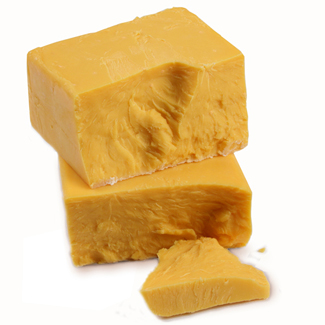
Now we come to what makes cheddar cheddar. Cheddaring is when after being heated, the curds are kneaded with salt before the whey is drained. After this, the cheese can be shaped and aged for any amount of time (longer = sharper). Harding said cheddar is supposed to be firm, mellow, and with a hint of hazelnut. It is also often orange, but this comes from added coloring, usually from paprika oil and/or annatto, a natural red dye that comes from a scary tree pod (see picture below).


And there you have it. That's all I learned about cheddar.

...except for this fact that I couldn't fit in anywhere: For the 1964 World's Fair in New York, Wisconsin created a 34,951 pound hunk of cheddar cheese from the milk of 16,000 cows.

Sources:
-Just wikipedia. Sorry.

June 22, 2010

LINKS: Blue cheese-- but not on purpose!

By Erica


In Turin, Italy this past Monday, 70,000 balls of fresh mozzarella were confiscated by the police when the several merchants and consumers noticed that the cheese mysteriously turned blue after it was exposed to the air*. The Italian Agriculture Minister, Giancarlo Galan, called the development "disturbing" and ordered laboratory tests.

The manufacturer of the cheese is a German company called Milchwerke Jaeger. They insist that the bacteria is harmless and that it affected only about ten of the mozzarella balls that were exported to Italy. Apparently, the bacteria is commonly found in ground water and has been filtered out of Milchwerke Jaeger's system. There have been no illnesses reported.

If the bacteria is indeed harmless, maybe this is the beginning of a new trend-- blue mozzarella! It would make for an interesting pizza.

Sources:
-Walletpop.com
-NY daily news
-Winnipeg Free Press

*Snicker-worthy descriptor of the tainted balls avoided with much difficulty.